

Stone Island occupies a distinct place in the minds of the style world. We are aware of the BADGE, the cult following, and what the brand means to the people who wear it. With such a unique and diverse collection, we wanted to dig deeper to better understand what goes into making the clothes. When Stone Island announced its No Seasons capsule collection, launching today, we saw it as the perfect opportunity to take a closer look. The No Seasons capsule shows how different materials can change a garment's persona. It’s cool to see the lengths Stone Island goes to innovate with silhouettes and materials. Because understanding how something gets made helps you see what's worth caring about.

No Seasons revisits a project Massimo Osti introduced in 1989, which ran until 1994. Osti founded Stone Island in 1982 after pioneering garment dyeing with mixed fabrics at C.P. Company. He approached clothing as an engineering project, and built a loyal following for it — his original pieces still fetch serious money on the resale market. He left the brand in 1994, but after talking with the design team about No Seasons, it’s clear his thinking hasn’t gone anywhere.


Different textiles in the No Seasons collection are dyed differently in an effort to give them each a unique look and coloring. “We use different coloring methods suited to the specific characteristics of each fabric.” The brand told us. Different materials absorb the same dye differently, meaning every garment comes out slightly different. “We aim to preserve the specific properties of each textile.” Stone Island said. These variations give each garment its own personality and texture, a process that compounds when you see the different variations together.
The Crinkle Reps version of No Seasons takes one jacket silhouette and makes it in six fabrics, all dyed “piombo” grey. The range is wider than it sounds —coated woven, wool cloth, iridescent nylon— each one a different material expression in the same shape. While researching this project, we realized this original concept already contained much of what Stone Island would become. The construction and materials have been updated for the way garments are made today, but the premise hasn't changed. Strip away the branding and ask a simple question: what can the material do?

Nylon is easy to dismiss as generic or inexpensive, but Stone Island has spent decades treating it as something worth developing. Nylon Metal, introduced around 2005, became one of the brand's signature fabrics because of its iridescent surface that shifts in the light. Crinkle Reps NY takes a different approach. Stone Island calls this area of development Material Science, a fitting description of the company’s approach to developing new materials and components.
The base fabric is a lightweight recycled nylon woven in a tight ribbed construction. “Reps” refers to that weave, and “NY” is simply Stone Island shorthand for nylon. The coating is applied to the inside face of the fabric, not the outside. This adds wind resistance and light weather protection, but it also changes the way the outer face accepts dye. The resin creates uneven uptake across the surface, which is where the crinkle comes from, and why every jacket comes out slightly different. During the dye bath, an anti-drop agent is added to the fabric. This means the jacket gets some of its weather resistance from the same process that gives it its color.

In person, it looks muted from a distance. Get closer and the crinkle comes through, shifting as the light hits it in a way that photographs don’t quite capture. The chest pockets have a specifically shaped bib panel, easy to miss until you’re looking for it. The snap cuffs and hood aren’t concealed the way they tend to be on modern outerwear. The hood takes some getting used to if you’re not a hood person. Once you have it in your hands, the No Seasons premise makes more sense. It wears like a Starter jacket designed by Dieter Rams. It’s light and breathable, but there’s enough structure to make it feel substantial without leaving you feeling exposed. It’s not built for a specific scenario, which some people will count against it. But most people don’t need something that specialized. And there’s the arm patch, which you’re welcome to remove.
Keeping the same silhouette across six fabrics turned out to be far more complicated than we’d assumed — shrinkage calculations, dyeing process, trims and secondary materials all had to be worked out separately for each version. The Crinkle Reps is the lightest of the six, and the crinkle effect is enhanced by the garment dyeing.
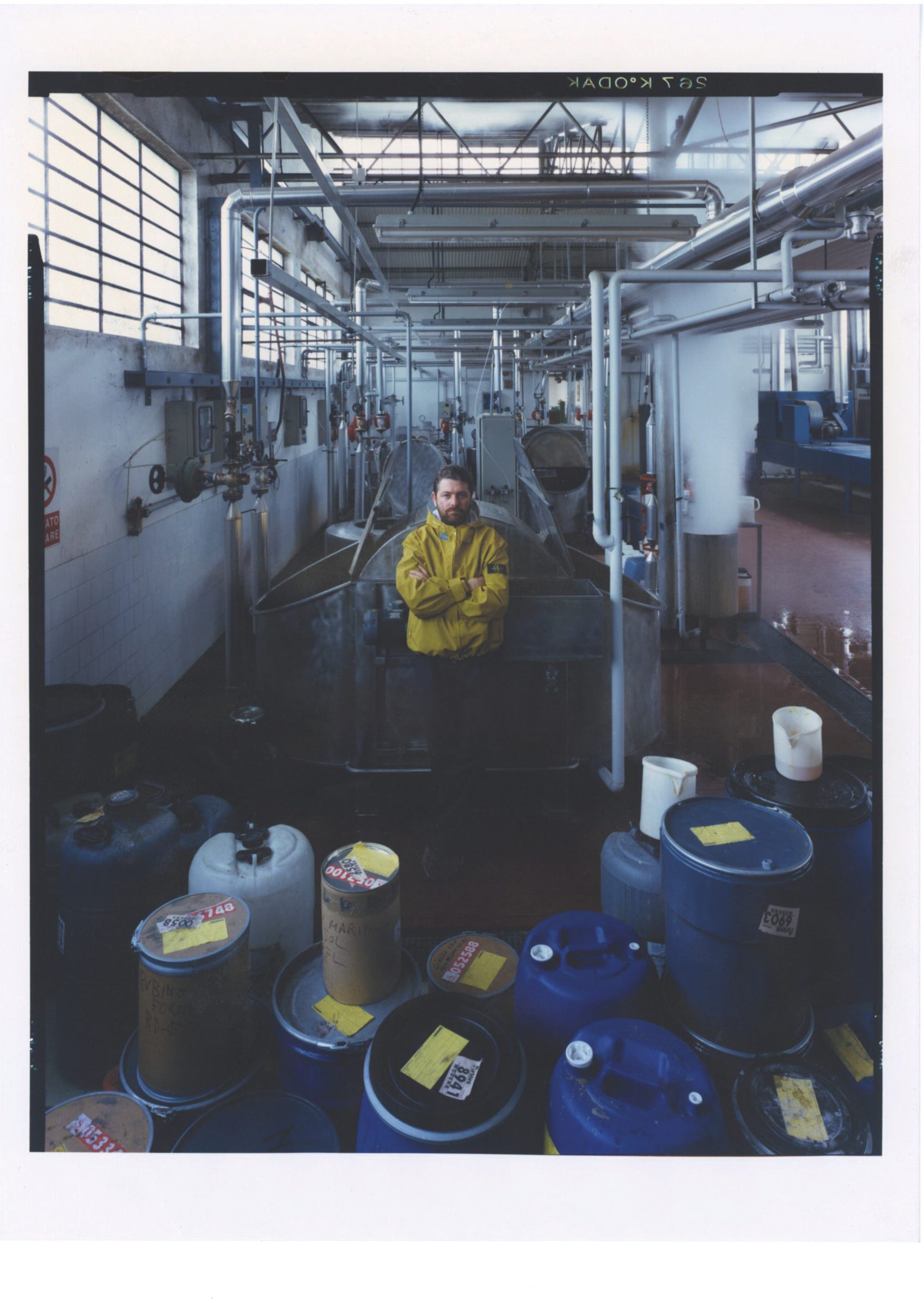
We were curious whether the dyeing process still held any surprises for Stone Island. The brand was clear about what it knows and what they don't. “We now know how the material reacts to dyeing processes, but in order to achieve the specific colour across the different textile elements that make up the garment, it is still necessary to test the specific result through lab dips and colour trials." We were told. Every production run starts from scratch. Stone Island also explained why they chose piombo rather than black. Grey reveals what the material absorbed. It makes the dyeing process visible.
We also asked how the jacket would change over time. Unlike other materials that evolve through use and washing, Stone Island said Crinkle is expected to remain as unchanged as possible. Much of the irregularity we associate with age —the uneven tone, the variation in texture— is already there the moment it's dyed. That character doesn't build up over time. It's already there.
This attention to detail and obsession with materials is what makes Stone Island and No Seasons so interesting. We started this conversation thinking about the badge. We left thinking about the grey.
Available at Stone Island stores and on www.stoneisland.com beginning today, October 19th.
